
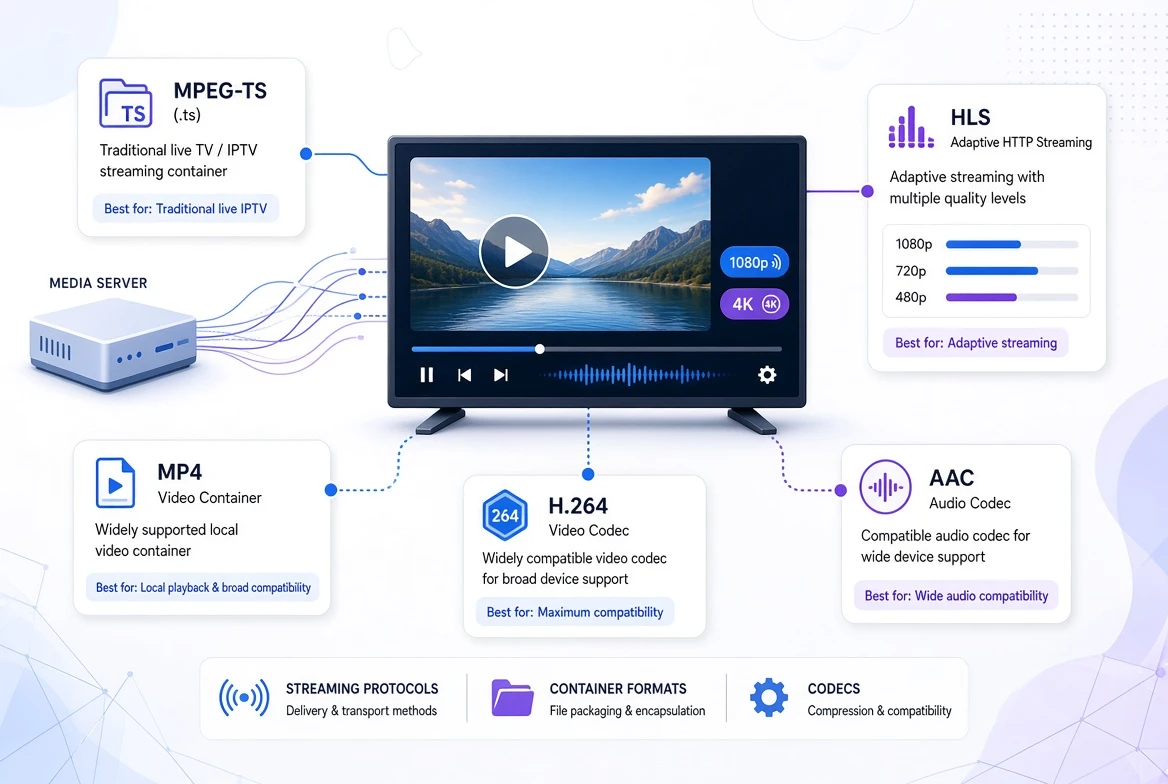
Choosing the best streaming format for IPTV depends on how the video will be delivered, what type of IPTV service or player is being used, the quality of the internet connection, and the devices used for playback.
There is no single video format that is perfect for every IPTV setup. For traditional live television and low-latency streaming, MPEG-TS (.ts) remains one of the most practical choices. For adaptive streaming over changing network conditions, HLS is often a better option because it can dynamically adjust video quality according to available bandwidth.
When it comes to video and audio codecs, H.264 combined with AAC provides one of the widest levels of compatibility across modern TVs, streaming boxes, smartphones, computers, and media players.
What Is IPTV?
IPTV stands for Internet Protocol Television. Unlike traditional broadcast television, IPTV delivers television programming and video content through an IP-based network.
IPTV can be used for live television channels, video-on-demand content, catch-up television, and other forms of internet-based video delivery.
What Is the Best Format for IPTV?
The answer depends on the type of IPTV streaming you are working with. MPEG-TS and HLS serve different purposes, so it is better to choose between them based on the delivery method rather than treating one format as universally better.
MPEG-TS (.ts) for Traditional IPTV Live TV
MPEG Transport Stream, commonly written as MPEG-TS or .ts, was designed for transporting audio and video streams in environments where continuous transmission and synchronization are important.
This makes MPEG-TS particularly suitable for traditional IPTV live television and other live-streaming scenarios where low latency and reliable continuous delivery are important.
HLS for Adaptive IPTV Streaming
HLS, or HTTP Live Streaming, takes a different approach. Instead of delivering one continuous transport stream, HLS divides video into smaller media segments and uses a playlist to tell the player which segments to request.
One of the biggest advantages of HLS is adaptive bitrate streaming. The player can switch between different quality levels depending on network conditions.
This makes HLS especially useful when viewers have unstable internet connections or when the same stream needs to support devices with different bandwidth capabilities.
MPEG-TS vs HLS for IPTV
| Feature | MPEG-TS | HLS |
|---|---|---|
| Traditional live TV | Excellent | Good |
| Low latency | Strong | Depends on configuration |
| Adaptive bitrate | Limited | Excellent |
| Unstable internet | Less flexible | Excellent |
| Traditional IPTV workflows | Excellent | Good |
Best Video and Audio Codecs for IPTV
The container or streaming protocol is only one part of the equation. IPTV compatibility also depends heavily on the video and audio codecs used inside the stream.
H.264 Video Codec
H.264 remains one of the most widely supported video codecs for streaming and playback. It provides a useful balance between image quality, compression efficiency, and hardware compatibility.
AAC Audio Codec
AAC is also widely supported by televisions, mobile devices, streaming players, computers, and other consumer hardware.
For a broadly compatible IPTV setup, H.264 video + AAC audio is therefore a practical combination.
IPTV Streaming Formats Explained
MPEG-TS
MPEG-TS is particularly useful for continuous live television delivery and traditional IPTV systems.
HLS
HLS is well suited to adaptive streaming and situations where network conditions change frequently.
MP4
MP4 is different from MPEG-TS and HLS because it is primarily used as a media container for stored video rather than being a live streaming protocol itself.
MP4 is particularly useful when the goal is to save a video file for playback on televisions, computers, smartphones, media players, or USB storage.
Which IPTV Format Is Best for Different Devices?
The best choice can also depend on the playback environment. A traditional IPTV receiver may handle MPEG-TS particularly well, while a modern streaming environment may benefit from HLS.
| Use Case | Recommended Choice | Why |
|---|---|---|
| Traditional IPTV live TV | MPEG-TS | Designed for continuous transport |
| Low-latency live delivery | MPEG-TS | Suitable for live broadcast workflows |
| Unstable internet connection | HLS | Adaptive bitrate streaming |
| Adaptive streaming | HLS | Multiple quality levels |
| Local video playback | MP4 | Broad device compatibility |
How TuneBoto Video One Fits Into Your Video Workflow
If your goal is not to operate an IPTV service but to prepare supported streaming videos for offline playback, the requirements are different from those of a live IPTV delivery system.
In this scenario, a common priority is compatibility with the television, media player, computer, or USB storage device where the saved video will be played.
TuneBoto Video One is designed for supported streaming services and can export supported video content into commonly used formats for offline playback.

 Free Download for Windows
 Free Download for macOS
IPTV Streaming vs Offline Video Playback
IPTV streaming and offline video playback solve different problems. IPTV formats such as MPEG-TS and HLS are designed around delivering streams to viewers, while a local video file such as MP4 is intended for storage and playback.
Streaming Service
↓
TuneBoto Video One
↓
MP4 / MKV Video File
↓
USB Drive / Media Player
↓
TV Playback
Frequently Asked Questions About IPTV Formats
What is the best format for IPTV?
It depends on the IPTV setup. MPEG-TS is a strong choice for traditional live IPTV and low-latency television delivery, while HLS is better suited to adaptive streaming over changing network conditions.
Is MPEG-TS good for IPTV?
Yes. MPEG-TS is widely suited to traditional IPTV live television workflows because it is designed for continuous transport of audio and video streams.
Is HLS better than MPEG-TS for IPTV?
Neither is universally better. HLS is generally more suitable for adaptive streaming and unstable internet connections, while MPEG-TS can be preferable for traditional live TV and low-latency IPTV delivery.
What codec is best for IPTV compatibility?
H.264 video combined with AAC audio provides broad compatibility across many televisions, streaming devices, computers, smartphones, and media players.
Is MP4 an IPTV streaming format?
MP4 is primarily a media container rather than a live streaming protocol. It is commonly used for storing and playing local video files.
Can TuneBoto Video One download IPTV streams?
TuneBoto Video One is designed for supported streaming websites and services. It should not be presented as an IPTV service or IPTV stream downloader.
Final Thoughts
The best streaming format for IPTV depends on what you are trying to achieve. For traditional live IPTV and low-latency television delivery, MPEG-TS remains a practical option. For adaptive streaming across changing network conditions, HLS offers important advantages.
When compatibility is the priority, H.264 video combined with AAC audio remains a practical choice for many consumer devices.
If your goal is instead to save supported streaming videos for offline playback on a TV, USB drive, computer, or media player, a local format such as MP4 may be more appropriate than an IPTV streaming protocol.
