
Reviewing third-party audio tools can be a total gamble. Some promise the moon but deliver nothing but error codes and compressed garbage. If you are currently wondering, "How is Tunepat Music One?" or looking for a comprehensive Tunepat Music One review that does not just copy-paste the marketing fluff, you have come to the right place. I recently purchased a license key, rolled up my sleeves, and ran this software through an intensive real-world testing session on a budget office computer.
If you are tired of paying for multiple music subscriptions just because your favorite songs are scattered across different platforms, you have probably looked into All-in-One downloaders. Let us skip the PR talk and see how it actually performs in everyday use.

✅ Part 1. What is TunePat Music One?
The 3-Word Summary: All-in-One, Fast, Full-Control.
At its core, TunePat Music One is basically a "get out of jail free" card for your streaming music. Instead of paying endless monthly rents to keep your favorite songs trapped inside twenty different apps, this tool lets you rip the actual files and lock them down on your computer forever. The real selling point here is "All-in-One". It literally crams Spotify, Apple Music, Tidal, and the rest of the gang into one single dashboard so you don't have to play musical chairs with your apps.


Quick Guide: How to Use TunePat Music One
Operating the software is incredibly straightforward, even if you are not a tech-savvy person. Here is exactly how I navigated the interface to get my music downloaded:
Step 1 Choose Your Source Platform
Open the program and select your preferred music streaming platform from the main dashboard. Depending on the service, you can choose to export music via the App mode or the Web Player mode.
Step 2 Select Your Tracks
Log in to your music account through the interface. Open the playlist, album, or artist you want to download, and click the "+" icon to parse and click the "Add" option to continue.
Step 3 Adjust the Settings for Best Quality
Change the output parameters on the "Settings" window. TunePat can support downloading music to MP3, FLAC, WAV, ALAC, AAC, and AIFF. Then, click the "Convert" button. The software will handle the rest and save the files locally.
✅ Part 2. Features & Live Test Data: The Budget Rig Challenge
To give you the most honest review possible, I did not use a top-of-the-line gaming PC. Instead, I threw TunePat onto an absolute potato of an office computer.
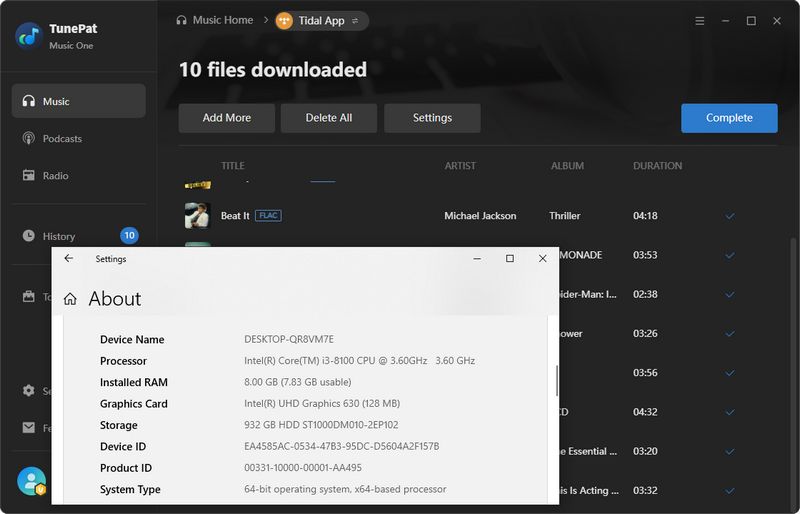
My Test Machine Specs:
- Processor: Intel Core i3-8100 (4 cores, 3.60GHz, which is very classic and very old-school)
- RAM: 8 GB
- Storage: A 1TB Mechanical Hard Drive (HDD). This is a spinning HDD that sometimes takes a few minutes just to open an Excel sheet.
- Graphics: Intel UHD Graphics 630 (Integrated)
If TunePat can run fast and smooth on this budget rig, it will fly on your computer. Here is exactly how my features and live data test went.
Feature 1: Massive Platform Support & Hi-Fi Audio Quality
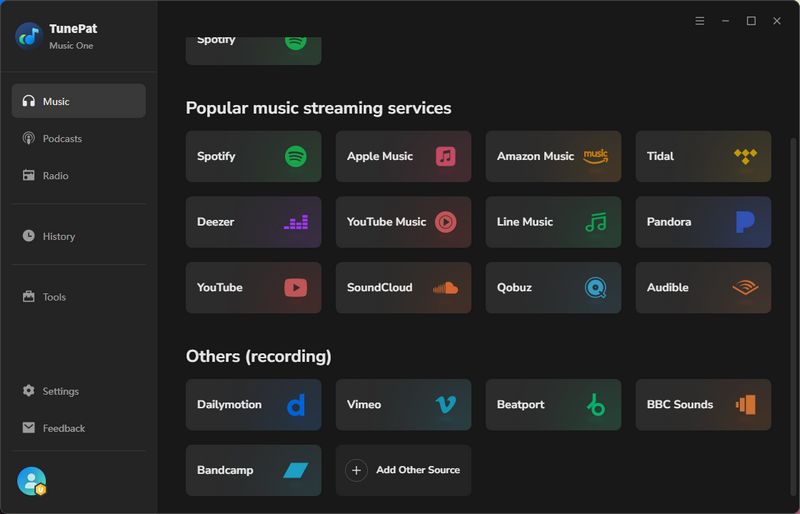
When you open the homepage, you are greeted by a clean layout of all the major streaming giants. Some platforms allow you to choose between fetching music from the App or the Web Player, while others, like Deezer and YouTube Music, rely solely on the built-in Web Player.
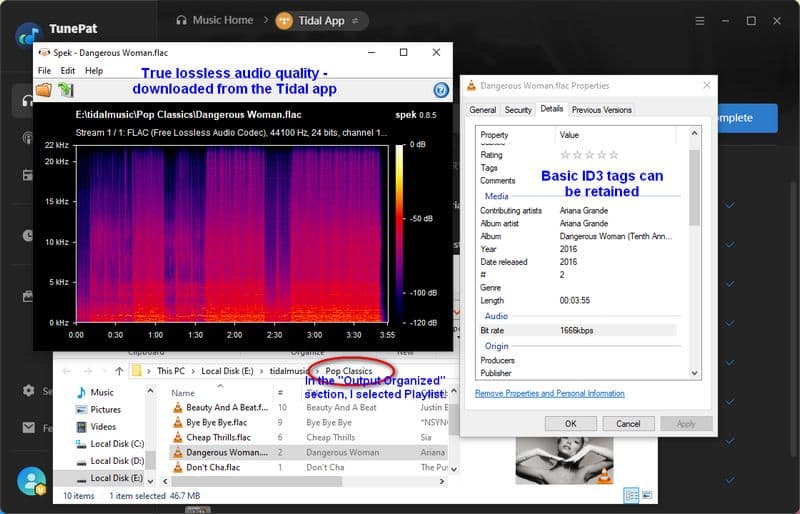
The Quality Test: I tested both free and premium accounts. My finding is that fetching music from the App mode consistently delivers higher audio quality than the Web Player mode, which makes sense given the source file differences. I tested my premium accounts on Tidal and Deezer, and the resulting audio quality was genuinely fantastic.
Organization: I checked the output folder structures as well. It supports multiple organizing methods like by Album or by Playlist. I tested the by Playlist output, and it worked flawlessly, keeping basic ID3 tags intact.
💡 Pro Tip for Audiophiles
If you want that true, uncompressed high-definition sound, your settings matter. You must make sure to choose to convert songs from the App when selecting your platform. Next, ensure the audio quality inside your official music app is set to the absolute maximum. Finally, go to TunePat output settings, set the Conversion Mode to Record Mode, and leave the output format as Recommended. Stick to this recipe, or the output quality might not live up to your expectations.
Feature 2: Batch Processing & Speed (The 11:45 AM Test)
Official claims state TunePat can hit up to 10X speed via Web Player mode, and around 5X via App mode. Since I prioritized audio quality, I focused my test on the Tidal App.
The Test Setup: I picked a Tidal playlist with 10 high-quality tracks. High-res lossless files are huge, which usually means slower downloads. Each song was between 3.5 and 4.5 minutes long, with a total playlist duration of roughly 35 minutes.
The Live Race: I started the conversion at exactly 11:45 AM. To push my poor i3 processor, I did not just let it sit there. I kept browsing news articles in my browser at the same time. I was a little nervous, half expecting the computer to freeze.
The Result: At exactly 12:00 PM, all 10 songs were successfully converted.
The Math: 35 minutes of music downloaded in 15 minutes flat settles at roughly 2.3X conversion speed. While it is lower than the advertised 5X, this is an incredible result considering it was pulling heavy, uncompressed FLAC files on an old i3 processor with a slow mechanical hard drive. I am highly satisfied. If you want that crazy 10X speed, just flip it to Web Player mode because it is a total speed demon.
Feature 3: One-Click iTunes Sync & Local Tools
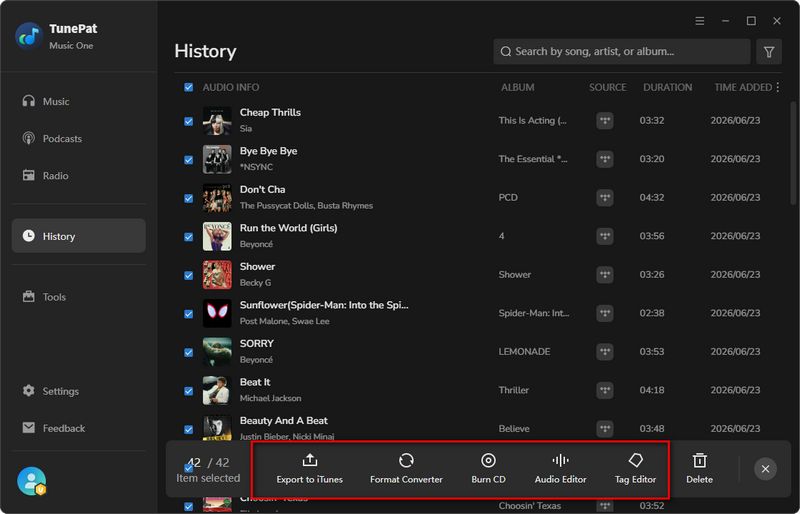
Once finished, the History module keeps everything organized. You can double-click any song to play it directly inside TunePat. However, like most users, I prefer using a dedicated media player, especially for lyric syncing.
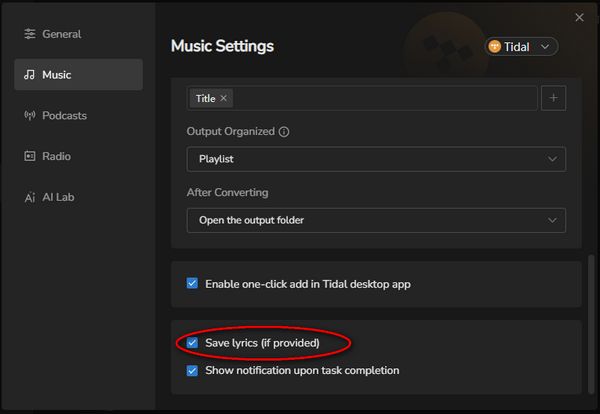
The Lyrics: TunePat supports downloading lyrics for platforms like Tidal, Spotify, Apple Music, and more, saving them as TXT or LRC files. You just need to toggle the switch in settings. Sadly, TunePat's internal player will not display scrolling lyrics while playing, so it is best used purely as a converter.
The Toolbox: Under the History module, you get cool bonus tools like an audio converter, a CD burner, a tag editor, and a one-click sync to iTunes button. This is a lifesaver for Apple ecosystem users. I do not use iTunes often, but I tested it. As long as iTunes is installed on your PC, you just click the button, type a playlist name, and it syncs over instantly.
Feature 4: Massive & Free Podcasts/Radio Downloader
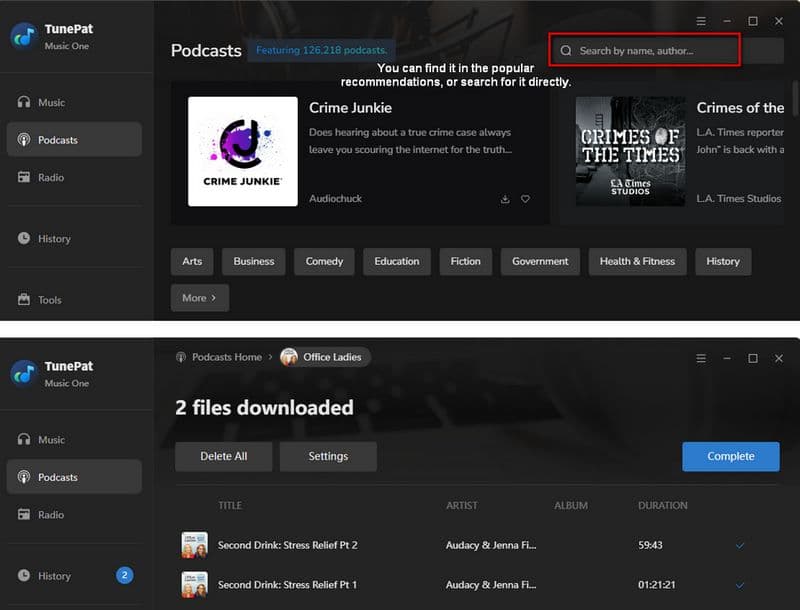
Look at the left sidebar, and you will find dedicated tabs for Podcasts and Radio. The layout is incredibly clean, sorting everything from mainstream blockbusters to deep indie niches. It hosts over 67,000 Radio stations and 120,000+ Podcasts, and all of them are completely free to access.
Podcast Test: I randomly picked two podcast episodes totaling about 2.5 hours. Because podcasts are mostly pure speech, they use much lower bitrates, around 128 to 192 kbps MP3, to save mobile data, storage, and server hosting costs. Because the files are so light, 2.5 hours of content is downloaded in less than 5 minutes. If you love hoarding podcast episodes, you will love this feature.
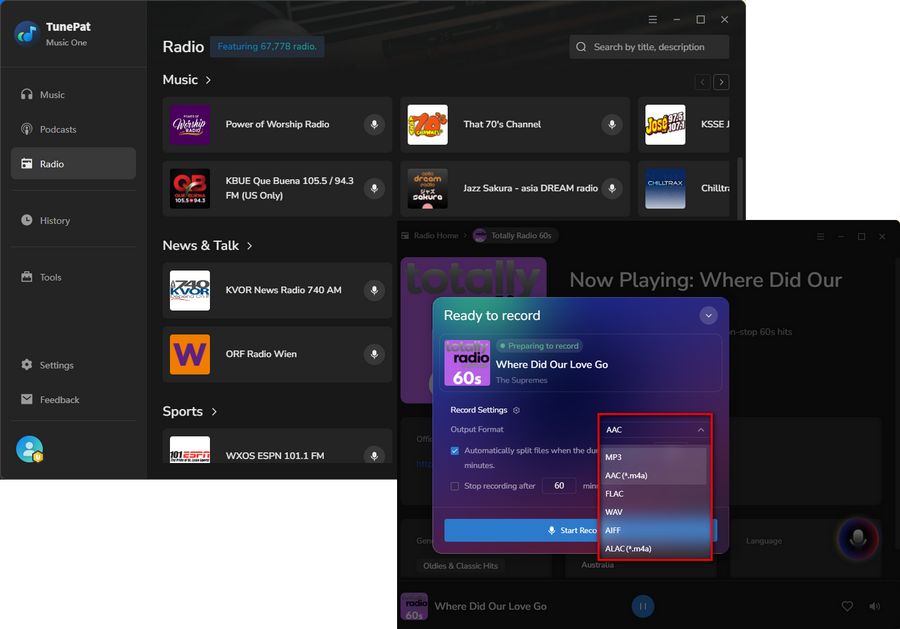
Radio Test: This acts more like a smart background recorder. You open a radio show, hit record, and you can even set a timer to automatically stop recording after a certain duration. Output formats supported include FLAC, MP3, AAC, AIFF, ALAC, and WAV.
Feature 5: Free AI Lab (Vocal & Instrumental Splitter)
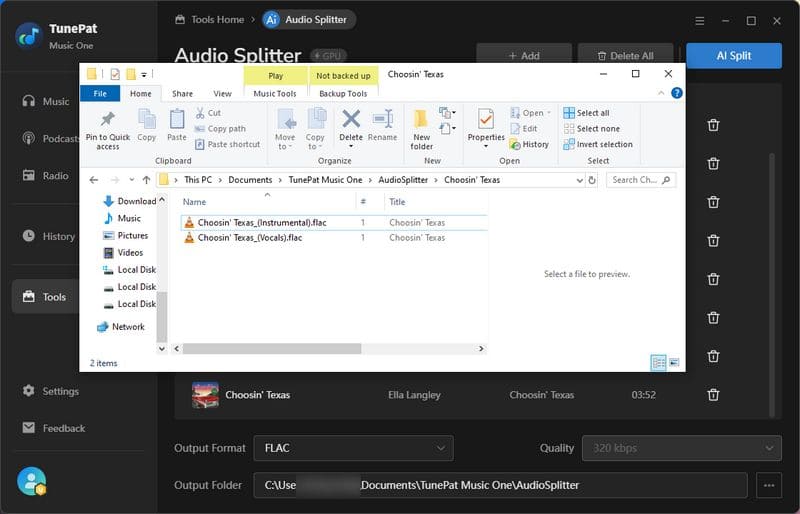
Tucked away in the Tools section is an AI Lab tool designed to separate audio tracks into distinct vocal and instrumental components. This feature supports batch processing, allowing users to handle multiple files simultaneously. Unlike several web-based alternatives that require payment after limited usage, this built-in tool is included without additional fees, delivering functional track separation that can be useful for creating custom karaoke tracks or music edits.
💡 Hardware Tip for the AI Lab:
When I launched it, the software warned me that no GPU was detected and that processing via CPU would be slower. Since my test rig runs on integrated Intel UHD 630 graphics instead of a beefy dedicated Nvidia graphics card, TunePat had to force my 4-core i3 CPU to carry the heavy load. The conversion took quite a long time, though it finished successfully. When I tested the same feature on my Mac, it was noticeably faster. If you plan to use the AI tool heavily, definitely bring a computer with better specs.
✅ Part 3. The Reality Check: What Do Other Users Complain About?
No software is perfect, and to keep this review 100% honest, we need to talk about the dark side. Based on real user feedback gathered from platforms like Trustpilot and various tech forums, I analyzed the most common complaints, the technical reasons behind them, and how to address them.
Account Risks if Overused (The Spotify Dilemma):
Some users on platforms like Trustpilot have mentioned account safety concerns, noting that downloading massive amounts of music can trigger automated flags on their streaming accounts.
The Reality: I reached out to their customer support team and dug through several forum threads regarding this issue. My takeaway is that Spotify's anti-scraping triggers are highly unpredictable, and this is a widespread industry bottleneck, not an issue unique to a single brand.
The Support Workarounds: When I asked the support team for advice, they suggested two official workarounds. First, you can choose to convert tracks without logging into your account at all. Second, they have recently rolled out a Spotify Library Backup and Restore feature. While the underlying risk is still a bit tricky to completely eliminate, this tool at least allows you to back up your full playlist structure to a local JSON file or snapshot, so you can restore it later or migrate it to other platforms like Tidal or Apple Music. Since I personally use Tidal and Apple Music more often, I have not encountered this issue myself, but I hope the developers can find a more permanent solution for Spotify users down the road.
The DRM Cat and Mouse Game:
Streaming services like Spotify or Apple Music constantly update their platform security and encryption. When they do, TunePat can occasionally throw up error codes or temporarily fail to convert tracks. Discussions on tech communities like Reddit highlight the clear frustration when this happens right before an urgent download. While some users find these sudden interruptions disruptive, others note that the technical support team is relatively consistent in rolling out patches to address these security overrides.
The Fix: If you hit an error, switching the software conversion source by toggling from Web Player to App mode or vice versa often serves as an immediate temporary workaround. However, because these encryption updates are an ongoing industry challenge, the most reliable long-term approach is to report the specific error code to their customer support team so they can expedite a permanent fix.
The Vanishing "Add" Button Bug:
Beyond backend server updates, there are isolated user reports on review sites mentioning sudden user interface glitches, such as the critical music-parsing button occasionally disappearing after setup. Coincidentally, I ran into this same glitch once during my own testing session, which confirmed that it does happen from time to time.
The Fix: While a simple program restart might not do the trick, I found an easy solution. Simply click the Menu button inside the software, select Clear cache, and then restart the program. This cleared the minor glitch and brought the button back instantly.
Licensing and Registration Code Glitches:
Another frequent wave of negative feedback involves registration codes, with users complaining that they never received their license keys after purchasing or that their active codes suddenly stopped working.
The Reality: As a consumer, I completely get the frustration. When you pay for a product and get locked out, it feels incredibly unfair and stressful. However, looking at the situation objectively, these issues are usually administrative misunderstandings rather than a scam. A missing code is almost always due to a minor typo at checkout or strict spam filters.
For existing users, sudden key failure often happens after a major operating system update. Another common reason is attempting to use the code on multiple devices. TunePat strictly enforces a one-license-per-device rule, so registering the key on a second computer triggers an automatic system block. While this restriction is a standard industry rule, the real downside for consumers is the international time-zone difference, as waiting hours for an email reply when you want to use the software right away is undeniably annoying.
The Fix: Do not just wait around in frustration. Contact support immediately to get your ticket started, but try these quick self-service troubleshooting steps while waiting for their reply:
- If you are a new buyer, check your spam folder right away and double-check whether you made a minor typo in your email address during checkout.
- If you are an existing user, ensure the code is not being used on another computer, then try restarting the software and re-entering your original credentials. If that still fails to reactivate it, let their customer support team sort it out for you.
✅ Final Verdict: Reasons to Buy & Reasons to Skip
Buyer Beware: If you aren't obsessed with audio quality and have no interest in hoarding local files, you can just swipe away and stick with your official apps. TunePat Music One is essentially a powerhouse tool built for those with very specific needs.
As long as you have a clear pain point, this software is incredibly worth it. For instance, if you subscribe to two different streaming platforms and find it annoying to constantly switch back and forth, or if you want to export your favorite tracks into various formats (whether it is standard MP3, high-spec FLAC and WAV, or Apple's ecosystem-friendly ALAC) to save them onto your hard drive forever, this serves as an exceptionally handy, ultimate music warehouse. On top of that, it also throws in free podcasts, radio, and AI tools.
However, no tool is perfect, and you must accept its fatal flaws before buying. Below is a quick-reference table for you:
Reasons to Buy 👍
- True All-in-One Hub: It supports Spotify, Apple Music, Tidal, Deezer, Amazon Music, YouTube, SoundCloud, and more under one single interface.
- Versatile Multi-Format Export: Extracts audio flawlessly into FLAC, WAV, MP3, AAC, AIFF, or ALAC depending on your exact storage and quality needs.
- Massive Free Content: You get free access to download over 120,000 podcasts and record from 67,000+ radio stations.
- Bonus AI Lab Included: It splits vocals and instrumentals cleanly for free without hitting you with an online paywall.
- Simple Self-Service Fixes: Most minor interface glitches, such as a temporarily missing parsing button, can be resolved instantly by the user simply clearing the software cache.
Reasons to Skip 👎
- The DRM Game: Major streaming security updates can occasionally cause brief conversion errors until TunePat releases an update.
- Account Risks (Spotify): Mass downloading hundreds of songs in a single day can trigger automated safety flags on your streaming accounts.
- Strict Free Trial: The trial version only converts the first minute of each song, making full-length testing difficult.
- No Instant Live Chat: While TunePat boasts a 100% response rate on major review platforms, they lack real-time live chat. Support operates via email across international time zones, meaning it can take 24 to 48 hours to resolve urgent license or technical issues.
Download the trial, test it with your favorite album, and let your own ears make the final decision.

